Do you live to run? Do you plan your day around your running? Do you try to get everyone you know to start running?
If you answered yes to any of these, you may have the runs. If you answered yes to ALL of them, you definitely do!

Gear Review - Avantree Jogger headphones


My first impression after opening the box and putting headphones in my ear (before attaching any earbuds) was that seemed a little flimsy. I have continual problems with headphones falling out of my ears when I run so I'm a little worried about this. But, I'm willing to give them a try. But not just yet. First I'm going to plug in the USB cable and charge them for a few hours as instructed.

Installing the Earbuds

After letting the headphones charge for several hours I put on the ear buds. They were a minor hassle, but I'm hoping this means they won't easily come off.

Pairing the Device

Following the instructions the headphones easily paired with my Droid Razr M.

First Use: Strength Training at the Gym

So far I'm impressed. These headphones are so lightweight that I sometimes forgot I was wearing them. The sound quality seemed pretty good as well. I'll admit that I'm no expert on sound quality, but it sounded pretty sharp to me.

First Run: 3 mile easy run

Okay, I've finally got a chance to run with these headphones and I must say that they are worth every penny. They never even threatened to fall from my ears and they are so lightweight I forgot I even had them on.

If you are looking for Bluetooth headphones to use for your runs, I highly recommend the Avantree Joggers.


Gear Review: Knuckle Lights


I saw a few people wearing these at the Run Woodstock 100 miler last year and I wanted to know if they were any good. At first I took the fact that they were not widely available as a bad sign, but I ordered them anyway from KnuckleLights.com (Side Note: "Knuckle" is one of those words, that no matter how many times you look it up, always looks misspelled when it's capitalized). Anyway I ordered them online and was very happy with how quickly they were delivered.

Most of my training runs are done so early in the morning that the sun hasn't even gotten up for his midnight pee. Therefore, it's quite dark when I head out. Unfortunately for me, I have also been cursed with an over-active imagination so the more light the better as far as I'm concerned. You never know what's around the next bend.


That is why I was very happy with the way the knuckle lights cast their light at a lower level than my headlamp, lighting up more than just the six feet of sidewalk ahead of me. It was also nice to be able to shine the light on any object around me without trying to lift up my head and stare down my nose.

My first run with the lights was a very cold December day, so I was wearing gloves but I felt no uncomfortable pinch or binding of the think elastic band. Adjusting them while running, however, turned out to be quite a chore.

On my third run with them, I was blessed with a 50 degree morning, so I was able to try them without gloves. I was surprised to discover they were more uncomfortable without the gloves. To get them adjusted properly while running took a bit of trial and error. It didn't help that I left my head lamp at home so I had to shine one hand on the other to see what I was doing. Eventually I got them just right, but they grew a little bit uncomfortable as my hands started to sweat.

However I was growing quite fond of how I could quickly switch them on or off with the thumb triggers as I passed through differing degrees of darkness. It was also nice to pass runners going the opposite direction without worrying about blinding them with my headlamp.

My fourth run with them was my first run in the woods. This is where I fell in love with them. The larger radius of light was the perfect antidote for my crazy imagination for it held all the nasties at bay.  Plus, when you hold your two fists together you feel like Iron Man blasting a beam of light into any rabid rodent that may be stalking you.

Verdict

If you generally run on roads that are familiar to you, and you aren't afraid of murderous moles or predatory possums then you could probably get by without these. However, if you plan on running trails or have the courage of a five-year-old you may want to pick up a pair.

I will leave you with one last piece of advice. If you do pick up a pair, I'd recommend not leaving your headlamp at home. There may be times when you need light but your hands are busy elsewhere.


Gear Review: Ultimate Direction Katoa '10

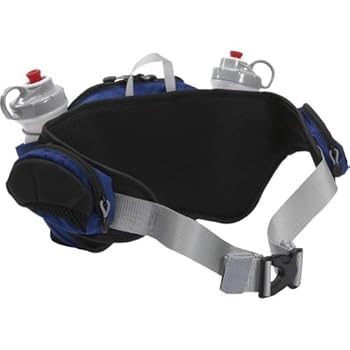
Since I was spending too much money on "Mission Hydration" I had decided to take a break when I discovered a great offer for the Ultimate Direction Katoa '10 from The Clymb.
Since I was able to get this pack for under $22 I figured I'd give it try. After all, my favorite single bottle pack is the Ultimate Direction "Access".

The first thing I noticed about the Katoa was the storage capacity.  The large compartment on the back of the pack has plenty room to hold my phone, keys, GU chomps, and emergency Glide. If I wanted to, I could even shove my rain shell in there (yes I have tested this). By cinching the bungee on the back I can reduce, but not eliminate, excessive jostling while running.

This pack also has two smaller side pockets which are the perfect size for two GU gels in each.

Seeing as how I still haven't figured out how to properly use an Ultimate Direction water bottle I swapped them with the two bottles I got with the CamelBak Delaney DC. The bungee loops that hook around the bottles are a tad frustrating when trying to hook them while running, especially when wearing several layers, but they do reduce bottle vibration.

I did have to tighten this belt more often during a run than with the other two packs, but since the belt clasp was in the in front it was easier to keep the pack centered than with the Delaney.

With the large pouch in the back, the two side pouches and the ability to carry 40oz of liquid, this pack lets me carry more than my customized Amphipod RunLite AirStretch 2.

Having done long runs with all three belts. I would rank them as follows.

Delaney AirStretch Katoa
Fit ** *** *
Jostling * *** **
Capacity ** * ***
Ease of Use * ** ***
Totals 6 9 9

Fit (how it felt while running, how often I had to tighten it)
Jostling (how much the belt and bottles bounced)
Capacity (how much I could carry without discomfort)
Ease of Use ( how easy it is to go from store to trail)

Seeing as how I've reach my budget limit for hydration options I guess I'm going to have to stick with the Katoa for now, at least until The Clymb has another good deal on a pack I haven't tried yet. Until the it's time to start Operation Illumination.

Gear Review: Amphipod RunLite AirStretch 2


Continuing my search for a hydration system that would work for my longer training runs, I have picked up an Amphipod RunLite AirStretch 2.


After dealing with the limited storage space offered by the Delaney DC I figured what could be better than a belt were I can add as much storage as I need.

The first thing I noticed about this belt was that there was no clasp or tightening straps. The Velcro system on the belt made sure it fit nice and snug and I never had an issue with it slipping or needing to be tightened.

The belt came with a pouch in the back and two bottles for hydration, but there are all sorts of ways you can customize this belt to your needs. Since I like extra storage, I purchased a secondary pouch that easily slid onto the belt.


The second pouch was perfect for my phone and a couple of gels. Now if there was somewhere I could put some GU Chomps for the really long runs. Hey! What do you know? Amphipod has something perfect for that.

I felt like Batman as I strapped all the cool things to my running utility belt and prepared to head out for my long run.
No, that's not me, but you have to admit, it's a cool costume.
This is when I discovered that the two flasks that came with the belt were only 10.5 oz each. This would mean that I would have to make more stops to refill my drinks.  I could add another flask to my belt but it would only bring my total fluid capacity to 31.5. I was hoping for at least 40 oz. Adding more flasks would help but the belt was getting pretty crowded by now.

This was when my infatuation of the RunLite began to fade. Not only were the flasks small but with narrow mouths they were a little messy to refill on the fly. Then there is the fact that I constantly lose my water bottles. I don't think I've ever returned home from an event with the same number of bottles I left with. Unfortunately none of the water bottles I've received as race swag would work with this belt so I would have to buy new flasks to replace the lost ones.

Although I do like the customization ability of this belt I think I will have to continue my search for a hydration system that suits me completely. However, I will keep this one on hand for my shorter runs where 21 ounces of fluid and a bag of GU Chomps are sufficient fuel.


Gear Review: CamelBak Delaney DC Waistpack


Now that I have decided to run the Burning River 100m, I am going to need to do some LONG training runs. This means that my single bottle waist pack will not hold sufficient liquid for proper hydration. It’s time to find a system that will allow me to run the long distances.. I already have to worry about poison ivy, hidden roots, horror movie villains and ninja skunks, I don't need to add dehydration to the list.

On one of my extended lunch hours I headed to REI, and  picked up the CamelBak Delaney DC.


The first thing I noticed about this pack were the two gel flasks that sit on either side of the front pouch. At first I thought this was a very cool design, but after squeezing several gel packs into the flasks, I realized it could be a very sticky process. For the record, energy gel is extremely sticky. I think they use it to hold heat panels to the space shuttle. Even after the flasks were filled and rinsed off (almost had to use Goop Off) I found that they got sticky again just from opening and closing them on my run. There is nothing fun about sticky fingers when doing a 20 mile run.

If I were to use this pack again I would just leave the gels in their packets where they do less harm. Unfortunately I would have to carry them in my pocket. With, the gel flasks taking up real estate on the pack the only pouch is the one in the front. Once I put my keys and phone in there I don’t have much room for any type of fuel that I would need for a long run

With gels flasks filled, I was ready to put on the pack. To put on this pack you have to clasp the belt in the back next to the water bottles. Not being able to see what I was doing, I spun around like a puppy chasing his tail a couple of times before success. Okay now the gel flasks are filled and the pack is on with the water bottles centered at the small of my back. Why is there a gel flask jabbing me in the belly button? Because there is a tightening strap on each side of the pack so cinching one side only results in an awkward fit. It took a lot of back and forth before I had the front pouch centered and every time I tightened the belt I had to make sure to tighten it on both sides or the pouch would start listing to one side.

The flasks are filled, the pack is on and centered, now it's time to run. Holy Bouncing, Batman. The two water bottles started bouncing so much that my MP3 player vibrated right of the belt. It took me about a mile to properly tighten the bottle cinch straps but once I did it was smooth sailing. Once all the adjustments are made the pack actually feels real comfortable. The bottles slide in out easily and there is very little bounce. Unfortunately my inability to use a gel flask without making a sticky mess, much like Pooh dipping his hand in honey, will keep me from using this pack again.

Does anybody want a slightly used CamelBak Delaney DC Waistpack, minus the water bottles. I'm keeping those. I seem to be losing a water bottle a month so I need to keep whatever I can.


Gear Review: Garmin Forerunner 305

A few weeks ago I finally silenced the cheap bastard that lives in my mind and purchased a GPS enabled running watch, The Garmin Forerunner 305.


Luckily I was able to get the watch from Amazon.com at a very reasonable price.

The first thing I noticed when I opened the box was how bulky it was. I was a little concerned that the size and weight of it was going to bother me on my runs. While I'm on the subject of initial concerns, I'll add a few more.

I should start this with an admission that I did not read too much about the watch before I bought it. I'm a bit of an impulse buyer so when I saw that a few of Twitter friends had it, I figured it was good enough to buy. Of course I could have asked them the following questions before my purchase, but what fun would that be?

- Does the 305 have the functionality needed for my interval running method? I am an avid follower of the Jeff Galloway running method.

- If it did allow interval running, would the notification be loud enough for me to hear it, even if I'm running by a busy road?

- Would the GPS receiver be strong enough to keep track of my runs through dense woods.

Throughout the next several weeks, I was able to discover the answers to each of these questions.

It took me a few times to figure out how to properly use the watch, but this could have been avoided if I had actually read the manual. Where's the adventure in that? Once I got the hang of it, starting up an interval workout is a breeze. The watch easily handles any type of interval workout you want to set up whether you want the intervals to break on time, distances or both. My only concern right now is that the intervals only allow 99 laps. My last run of 14 miles took 52 "laps" so I'm worried that as I train for my 50M race, this limit may force me to split my workouts.

As for the interval notifications, the multiple beeps that are emitted at the end of each interval have proven to be loud enough for me to hear, even when running along a fairly busy street. I'm not sure if it could be heard running on the interstate, but there is a limit as to how far I'll go for a review.

I have also found that the GPS receiver is strong enough to track me on all my off road adventures so far. From the woods of upper Michigan to the mountains of Virginia.

The ability to upload the data to Garmin Connect Online then sync it to my Daily Mile account has proven to be a valuable benefit as well.

All things considered I have found this to be a great running watch, and well worth the price. It's great to just grab a water bottle, strap on my watch and head out the door for a run.


Gear Review: Auria Exceed Headphones

While wandering around the expo before the Flying Pig marathon in Cincinnati, I saw two young women violently shaking their head with headphones in their ears. These were not wrap around, or over the top headphones, they looked like typical ear bud headphones but they were not falling from the ears of the head banging duo. This got my attention, so I made my way to the Exceed Headphone booth.

"Want to try out a pair?" asked the man who seemed to be in charge.
"Sure why not." I told him.
"Let me have a look at your ear to see your size" he said. I was momentarily taken aback by this but I turned my head anyway. "You have a larger ear." he told me.
"Uh thanks," I replied.

After putting the "large" fitting on the headphones he stuck them in my ear and told me to jump around and see if I could shake them loose. Low and behold! I could not shake the things from my ears. I was impressed enough to consider purchasing a pair. When I saw that they had a model that gave me control over the volume and manipulation of tracks I was drawn in further.

"Do these work with Android phones?" I asked.
"Who is your provider?" he asked in return.
"Verizon"
"Our headphones work with all Verizon phones." he answered me confidently. I was sold. After shelling out the $35 for my new headphones, I couldn't wait to try them during the marathon.

The next morning I eagerly put on my new headphones. A small voice whispered that I should probably put my old ones in my pocket just in case. I don't know why my wife was whispering, there was nobody in the room with us.

After only a mile into the race the head phones kept popping out of my left ear. I would jam it in harder and it would fall out again. The right side stayed put, but the left kept falling out. Frustrated I let it dangle inside my jacket. The volume control worked perfectly but I soon discovered that the "next track" option did not work with my Android phone. Later, after the race I would discover that none of the extra functions worked with my phone regardless of what music playing app I was using.

Around mile 5 the headphones quit working completely. I will give them the benefit of the doubt and say it may have been caused by the rain. I swapped my $35 dollar headphones with my $9.99 Sony headphones. Although I lost the ability to control the volume of my music, both headphones stayed in place and worked perfectly in the rain.

I will never again be swayed by head-banging girls. Okay, that may not be true. But I will never be convinced to spend more than $10 for a pair of headphones.